
Choosing a pillow block bearing isn’t just a housing preference—it directly affects shaft alignment, downtime risk, corrosion performance, and total cost of ownership. While many engineers default to cast iron out of habit, stamped steel pillow block bearings can be the smarter, more modern choice for many light-duty and OEM applications.
At LDK, we’ve spent 30+ years manufacturing mounted bearing units across common housing materials and standards—so this guide is built around what actually works in the field, not just what looks good on a spec sheet.
Stamped steel pillow block bearings use precision-formed steel sheet housings (commonly zinc-plated, with stainless options in certain product lines). They’re engineered for compactness and repeatability—especially valuable for OEM builds and space-constrained equipment.
Lightweight, compact form factor: easier handling, less machine mass, and better fit in tight assemblies.
Zinc-plated housing: often delivers stronger real-world corrosion resistance than standard painted cast iron in humid or washdown-adjacent environments.
Two-piece separable housing: simplifies insert bearing replacement (less downtime, fewer headaches for MRO teams).
Designed for practical alignment: useful where mounting surfaces and tolerances aren’t perfect.
Light-duty bearing units
HVAC systems (fans/blowers)
Agricultural machinery
Conveyors and small material handling
Lawn and garden equipment
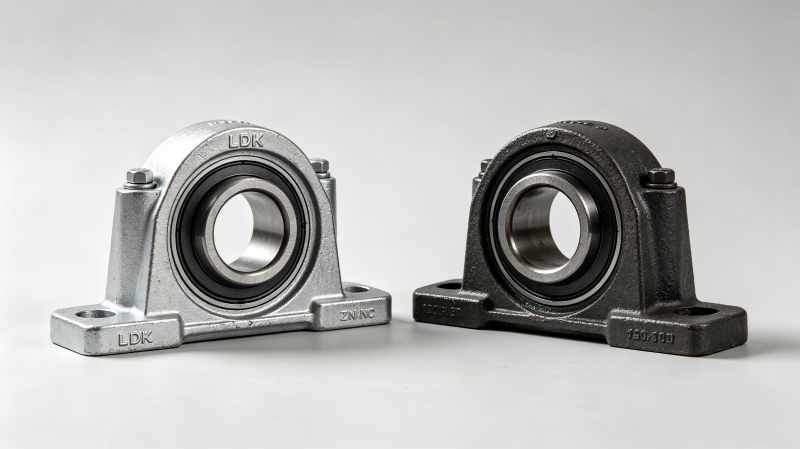
Cast iron pillow blocks (gray or ductile iron) are the traditional go-to in heavy industry because they’re built for rigidity and stability under demanding loads.
High rigidity: better resistance to deformation under high radial loads.
Superior vibration damping: helpful for equipment that induces shock or persistent vibration.
Heavy construction: stability advantage in harsh, high-load conditions.
Heavy-duty industrial machinery
Mining and aggregates (shock loads)
High-vibration environments
Large power transmission systems
Cast iron pillow blocks (gray or ductile iron) are the traditional go-to in heavy industry because they’re built for rigidity and stability under demanding loads.
High rigidity: better resistance to deformation under high radial loads.
Superior vibration damping: helpful for equipment that induces shock or persistent vibration.
Heavy construction: stability advantage in harsh, high-load conditions.
Heavy-duty industrial machinery
Mining and aggregates (shock loads)
High-vibration environments
Large power transmission systems
| Factor | Stamped Steel Pillow Block Bearings | Cast Iron Bearing Housing |
|---|---|---|
| Weight | Typically ~60% lighter (varies by size/design) | Heavy and stable |
| Cost | Often more economical for high-volume OEMs | Often higher material + shipping costs |
| Radial load capacity | Optimized for light-duty loads | Better for heavy radial loads |
| Vibration damping | Lower than cast iron | Excellent damping |
| Corrosion resistance | Zinc-plated/stainless can outperform basic painted iron in humidity | Painted surfaces can chip; rust risk if coating is damaged |
| Space constraints | Compact, easier to package | Bulkier footprint in many designs |
| Serviceability | Two-piece housing often makes insert swaps simpler | Durable; service depends on unit style |
Many OEM teams choose stamped steel for efficiency and sustainability reasons: reducing machine weight can lower shipping costs and improve energy consumption during operation (especially for fan systems, conveyors, and mobile equipment).
Self-alignment note: LDK’s stamped units are designed to accommodate initial self-alignment (up to ±2°), helping compensate for minor mounting inaccuracies and shaft misalignment—a common real-world issue during assembly and field replacement.
Choose stamped steel pillow block bearings when you need:
Compact assemblies and lower overall machine weight
Better corrosion performance via zinc-plated housing (or stainless options for certain environments)
Practical alignment tolerance for real-world installs
Efficient purchasing for high-volume OEM production
Common use cases:
Conveyors (light-duty)
Food packaging lines (especially where stainless options apply)
Fans and blowers (HVAC)
Lawn/garden and light agricultural equipment
Choose cast iron pillow blocks when you’re dealing with:
High radial loads, heavy belt tension, or shock loading
High vibration where damping matters most
Harsh industrial settings where rigidity is the priority
Common use cases:
Rock crushers and screening equipment
Heavy manufacturing lines
Large-scale power transmission
Housing material matters—but maintenance access and lubrication discipline often matter more.
LDK stamped steel units may be offered lubricated-for-life (for appropriate duty cycles) or with accessible grease fittings for easy service, depending on the unit configuration. For MRO teams, that means your decision should consider:
Can technicians grease it safely and consistently?
Is the unit exposed to washdown, dust, or chemical mist?
Does the insert bearing use a locking method (e.g., eccentric locking collar or set screw) suited to your speed/torque profile?
Engineer’s Tip (Experience): When installing stamped steel units, ensure the mounting surface is flat and properly torqued. An uneven base can distort the housing slightly, contributing to premature noise, heat, and reduced bearing life.
Standards note: For procurement confidence and interchangeability planning, select units aligned with applicable ISO, JIS, or North American dimensional practices (LDK manufactures across common market expectations—confirm the series before standardizing across sites).
Use this as a fast screening tool:
You prioritize lower weight and compact design
Loads are primarily moderate radial, not heavy shock
Your environment is humid or mildly corrosive (zinc plating helps)
You need repeatable OEM assembly and cost efficiency at scale
Minor shaft misalignment may occur during installation
If you answered “yes” to most, stamped steel is likely a strong fit.
Yes—speed capability depends more on the insert bearing design, sealing, lubrication, and temperature than the housing material alone. Confirm RPM, load, and sealing requirements with the bearing series/spec.
In many common series, yes—LDK designs for high interchangeability across widely used mounted bearing dimensions. Always verify exact series, bore size, and mounting dimensions before cross-referencing.
It’s not about which housing is “better”—it’s about which is right for your load, environment, space constraints, and maintenance reality.
Choose stamped steel pillow block bearings when weight, corrosion performance, packaging, and OEM efficiency matter most.
Choose cast iron when maximum rigidity, heavy radial load capacity, and vibration damping are non-negotiable.
Not sure which housing fits your torque and load requirements? Explore LDK’s Stamped Steel Catalog or contact the LDK engineering team for application-specific selection support.


