
Chemical processing lines don’t fail gently. When bearings begin to corrode, seize, or lose lubrication, the result is often unplanned downtime, contaminated product risk, emergency maintenance labor, and ripple effects across upstream and downstream operations.
That’s why more reliability teams are shifting from “stronger metal” thinking to “smarter material” thinking—specifically, self-lubricating plastic bearing units engineered to thrive in corrosive, washdown-heavy, chemically aggressive environments.
Chemical plants combine the harshest failure accelerators in one place: acids, alkalis, solvents, humidity, washdowns, temperature swings, and airborne particulates. Even stainless steel can degrade over time, especially when exposed to chlorides, aggressive cleaning agents, or chemical splash zones.
What it looks like in the field:
Pitting and crevice corrosion around seals, set screws, and interface points
Oxidation that increases friction and heat
Surface damage that turns into vibration, noise, and premature fatigue
Metal bearings often depend on external grease to survive. In chemical environments, grease can become a liability:
Washdown removes grease, leaving metal-on-metal contact
Chemicals attack thickeners/additives, breaking down lubrication performance
Over-greasing attracts dust and solids, forming abrasive paste
Incompatible greases cause softening, bleeding, or hardening—then failure
In chemical facilities, a “simple bearing failure” isn’t simple. It can mean:
shutdown coordination,
lockout/tagout procedures,
safety permits,
production loss,
expedited parts procurement,
and quality risk.
Self-lubricating solutions are often evaluated not just on unit price—but on Total Cost of Ownership (TCO).
Self-lubrication is not “plastic is slippery.” It’s engineered tribology.
High-performance plastic bearing units can use engineered polymers such as PBT (Polybutylene Terephthalate) or POM (Polyoxymethylene) with solid lubricants dispersed throughout the polymer matrix. That means lubrication is present through the wear life of the bearing—not applied from the outside.
This is especially valuable for:
splash zones
high-humidity areas
washdown-ready systems
chemical exposure points
A key tribological advantage is the transfer film phenomenon: under operation, a microscopic lubricating layer can form between the bearing and shaft. This reduces:
coefficient of friction,
heat generation,
wear rate,
and the dependence on manual re-lubrication.
In practical terms: self-aligning plastic bearings can keep moving reliably even when grease-based systems become inconsistent or impossible to maintain.
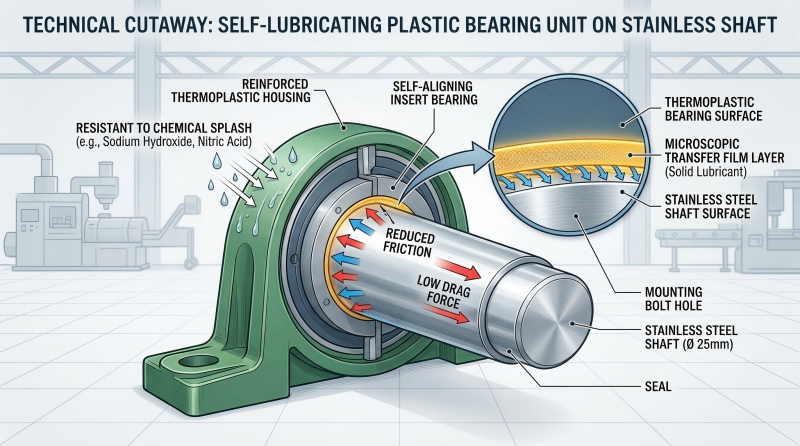
Plastic housings are inherently corrosion-proof—not just coated. No coating to chip, no plating to fail, no rust bloom to spread. For many chemical plant zones, that alone is a reliability upgrade.
Material choice matters. PBT is often selected for industrial environments because of its strong resistance profile against many:
detergents,
industrial cleaners,
and a range of solvents.
(Always confirm compatibility with your exact chemical exposure, concentration, and temperature—chemical resistance is never “one-size-fits-all.”)
In facilities where chemical processing overlaps with food, beverage, or hygiene-adjacent production, housings that resist bacterial growth can support cleanliness programs and reduce biofilm concerns—especially in wet zones.
Plastic bearing units are typically lighter than cast iron or heavy metal housings, which can:
simplify handling and installation,
reduce load on supporting structures,
and marginally improve energy efficiency in certain rotating systems.
| Feature | Stainless Steel Bearing Units | LDK Plastic Bearing Units |
|---|---|---|
| Corrosion Resistance | High, but can pit/crevice corrode in harsh media | Inert housing; corrosion-proof |
| Need for Manual Greasing | Often required (depending on design) | Typically maintenance-free (self-lubricating) |
| Resistance to Acid Exposure | Varies by grade and conditions | Material-dependent; can be excellent with correct polymer selection |
| Weight | Higher | Lower |
| Risk of Contamination | Grease purging/leakage risk | No grease needed (lower contamination risk) |
Not all “plastic bearings” are equal. In chemical plants, the difference between success and failure often comes down to materials engineering, manufacturing precision, and application support.
A qualified plastic bearing manufacturer should be able to demonstrate:
repeatable manufacturing (e.g., precision injection molding),
controlled tolerances for inserts and housings,
material traceability and test data,
and application guidance (load, speed, temperature, chemical exposure).
LDK’s approach should be positioned as engineered solutions, not commodity plastics.
Chemical environments vary widely by:
pH level,
exposure type (continuous immersion vs. splash),
operating temperature,
shaft material,
and washdown frequency.
A manufacturer that collaborates with your maintenance/reliability team can help specify the correct insert/housing combination for your conditions—especially when designing for chemical exposure and service life.
If your plant is still treating bearing failure as a routine consumable cost, it may be time to reframe the problem.
Plastic bearing units can deliver measurable ROI by reducing:
corrosion-related failures,
manual lubrication labor,
washdown downtime,
and secondary damage to shafts and surrounding components.
When you factor in TCO—maintenance hours, spare parts, lost throughput, and reliability risk—self-lubricating plastic solutions often outperform metal in chemical processing conditions.
No. Self-lubricating plastic bearing units are designed to operate without external grease, reducing washdown failure risk and contamination concerns.
Yes—when engineered correctly. Industrial-grade polymers and bearing designs are used for chemical applications with demanding loads, speeds, and environmental exposure.


