
In mechanical power transmission, choosing the right mounted bearing housing style determines the structural stability, vibration damping, and longevity of a rotating shaft. Flange bearing units are essential components across conveyors, agricultural machinery, food processing equipment, and industrial drivetrains. They bolt directly onto a machine frame perpendicular to the shaft axis, offering a self-contained, pre-lubricated solution that simplifies assembly.
However, mechanical engineers and procurement managers often face a critical design question: Should you specify a 2-bolt, 3-bolt, or 4-bolt configuration? Selecting the wrong housing type can lead to structural fatigue, housing fracture, or premature internal bearing failure. This guide breaks down the technical differences, load profiles, and application environments for each type to ensure you make an optimized choice for your equipment.
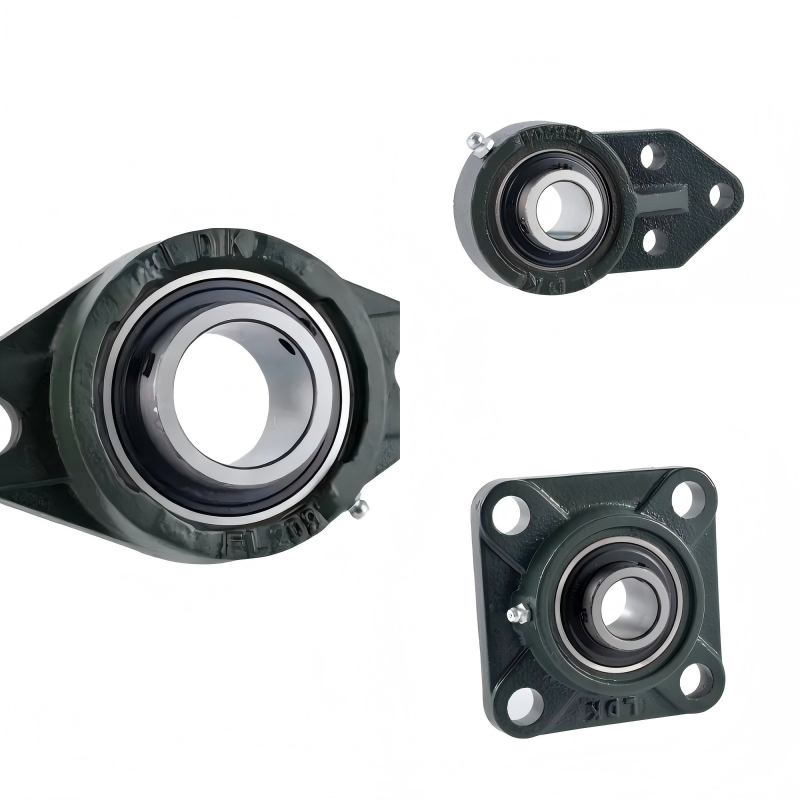
Before comparing bolt configurations, it is important to understand the anatomy of a flanged bearing unit. Every unit relies on a cohesive integration of components designed to handle specific mechanical stresses:
The Core Combination: Each unit integrates a cast iron, ductile iron, or pressed steel flanged housing with a wider inner ring ball bearing insert.
Self-Aligning Capability: The bearing insert features a spherical outer diameter that mirrors the concave internal machining of the housing. This layout allows the bearing insert to pivot slightly to compensate for minor static misalignment or shaft deflection without binding.
Shaft Locking Methods: Securing the bearing assembly tightly to the shaft is achieved through specialized locking mechanisms, including set screws, eccentric locking collars, adapter sleeves, and concentric locking collars.
Tailored Lubrication: To maintain reliable operations under varying load conditions, manufacturers pre-fill these spherical insert bearings with application-specific lubricants, ranging from standard industrial lithium grease to high/low-temperature lubricants or specialized food-grade grease.
Contamination Protection: For systems operating in harsh conditions, pressed steel end covers or caps can be attached to the housing to provide an extra layer of protection against external pollution, fine dust, and moisture ingress.
When structural space is constrained and load requirements are light to moderate, 2-bolt flange units offer the most efficient engineering solution. These units feature a diamond-shaped housing with two mounting bolt holes positioned diametrically opposite each other across the bearing center.
Compact Physical Footprint: By utilizing only two anchor points along a single axis, these units require minimal mounting surface area.
Enclosure Fit: They are ideal for installation on the side-walls of narrow machinery chassis, compact conveyor frameworks, and tight modular equipment layouts.
FL200 Series: The industry standard for standard-duty applications.
FLX Series: Provides increased housing thickness and robust casting for medium-duty tasks.
FL300 Series: A massive cast iron body engineered for severe operations and higher load thresholds.
FLU200 Series: Specifically designed for applications requiring a higher central height.
LF200/FW200/FD200 Series: Lightweight options constructed from pressed steel or ductile iron for weight-sensitive machinery.
While less common than their 2-bolt and 4-bolt counterparts, 3-bolt flange mounted bearings fill a critical engineering gap where unique loading forces require multi-directional support without the large footprint of a square 4-bolt unit. These units feature a round or triangular-shaped housing with three bolt holes spaced equally around the perimeter.
Triangulated Mounting Pattern: In structural mechanics, a three-point attachment provides a highly stable plane.
Uniform Force Distribution: This configuration distributes both radial loads and moderate axial thrust loads more uniformly than a two-point linear arrangement.
Anti-Rocking Stability: The triangular design prevents the housing from rocking or experiencing micro-movements when the shaft undergoes alternating rotational directions or cyclical shock loads.
FB200 Series: The primary standard-duty cast iron configuration used across traditional industrial machinery.
FCT200 Series: A light-duty series utilizing high-strength ductile iron, engineered for applications where weight reduction and material toughness are critical.
Common Industry Uses: Widely applied in agricultural machinery, commercial sorting equipment, and industrial fans where the mounting surface accommodates a triangular bolt pattern and the shaft requires robust, non-yielding support.
For high-load industrial machinery, the 4-bolt flange bearing stands as the industry standard for structural permanence and maximum load capacity. These units feature a robust, square cast iron or ductile iron housing with four mounting holes positioned at each corner of the flange square.
Maximum Rigid Clamping: The 4-bolt configuration provides the highest rigidity and load-carrying capacity among all flanged bearing options.
Minimized Stress Concentration: By distributing the operational forces across four symmetrically placed structural bolts, this design minimizes stress concentrations on the machinery frame and the housing itself.
Extreme Deflection Resistance: The square geometry provides exceptional resistance against severe radial forces, heavy axial thrust loads, and sudden shock inputs, making it virtually impossible for the housing to deflect during operation.
F200 Series: The baseline standard-duty square configuration.
FX Series: A medium-duty option offering reinforced housing structures.
F300 Series: Designed for the most demanding industrial applications, featuring thick cast walls and wider casting profiles.
FS200 & FS300 Series: Heavy-duty options engineered for applications requiring a higher central height paired with extreme structural integrity.
Common Industry Uses: The preferred choice for heavy aggregate conveyors, mining equipment, industrial mixers, and primary paper processing machinery.
To help engineering teams select the correct flanged unit for their specific system parameters, the following matrix compares the core physical and performance attributes of each style.
| Technical Attribute | 2-Bolt Flange Units | 3-Bolt Flange Units | 4-Bolt Flange Units |
|---|---|---|---|
| Housing Geometry | Diamond-shaped / Oval | Triangular / Circular | Square |
| Common LDK Housings | FL200, FL300, FLX, FLU200 | FB200, FCT200 | F200, F300, FX, FS200, FS300 |
| Load Capacity Envelope | Light to Medium | Intermediate Balanced | Heavy Duty / Severe Duty |
| Space Requirement | Minimal (Ideal for tight areas) | Moderate (Requires circular area) | Maximum (Requires large square footprint) |
| Vibration Damping | Moderate | High (Triangulated stabilization) | Maximum (Four-corner rigid distribution) |
| Locking Mechanisms | Set screws, eccentric/concentric collars, adapter sleeves | Set screws, eccentric locking collars | Set screws, eccentric/concentric collars, adapter sleeves |
Selecting the ideal mounted bearing configuration requires a systematic evaluation of your mechanical system's operating parameters. Engineering teams should evaluate three primary pillars before finalizing a specification:
Load Direction and Magnitude: If the forces acting on the shaft are primarily radial and predictable, a 2-bolt assembly is often sufficient and highly cost-effective. However, if the shaft experiences axial thrust forces—such as in an inclined screw conveyor—or alternating heavy forces, a 4-bolt flange bearing is required to safely clamp the unit to the frame and prevent metal fatigue.
Available Mounting Space and Envelope: Narrow frames or compact machinery enclosures naturally limit your choices to a 2-bolt layout. Conversely, if space is open but the frame is prone to flexing under operation, installing a 3-bolt unit can provide excellent multi-directional stabilization without adding the bulk of a 4-bolt casting.
Environmental Threats and Accessibility: For high-dust or wash-down applications, ensure the housing style can accept steel end covers. If the bearing is mounted in a hard-to-reach area, specifying a heavy-duty housing equipped with custom lubrication channels and high-grade grease can significantly extend the maintenance intervals, reducing overall operational costs.
Understanding the structural differences between 2-bolt, 3-bolt, and 4-bolt flanged bearing configurations allows engineers to balance space constraints, load profiles, and maintenance requirements effectively. Selecting the correct housing style ensures optimized power transmission, minimal shaft deflection, and protection against premature mechanical failure.
With over 30 years of manufacturing experience, LDK Bearings delivers high-tech, customer-oriented solutions for global industrial applications. From our 100,000 square meter production facility equipped with cutting-edge testing laboratories and precision measuring rooms, we produce standard and customized bearing components tailored to your specific material and load requirements. To find the ideal component for your machinery, explore the LDK Bearings Product Catalog or connect with our engineering team through the Contact Page for specialized selection support.
Generally, 2-bolt units are designed for light to medium-duty applications. For heavy shock loads, a 4-bolt configuration is highly recommended because it distributes sudden forces across four structural anchor points, preventing housing fracture.
Ductile iron, such as that used in the FCT200 series, provides higher tensile strength and fracture toughness compared to traditional gray cast iron. This allows the housing to absorb higher impacts and vibrations while maintaining a lighter weight profile.
End covers physically seal the bearing insert from external pollution, abrasive dust, and moisture. This is vital in agricultural or food processing industries where airborne particulates or high-pressure wash-downs can contaminate the grease and destroy the internal raceways.
For high-speed or reversing applications, an adapter sleeve or a concentric locking collar is preferred. These methods provide 360-degree uniform clamping around the shaft, minimizing eccentricity and reducing high-speed shaft vibrations compared to standard set screws.


