
Supporting a rotating shaft is relatively straightforward when a bearing can be mounted on a flat machine frame. The situation changes when the shaft must be supported from above or positioned within a suspended structure. In these applications, the housing design, mounting connection and shaft locking method become just as important as the bearing itself.
A hanger unit bearing combines a bearing insert with a housing designed for hanger-style mounting. Instead of using the conventional base found on many mounted bearing units, the housing can be connected to a supporting structure through a threaded mounting arrangement. This makes hanger units useful where equipment layout requires shaft support from a suspended or intermediate position.
Selecting the correct unit should therefore begin with the installation geometry. Shaft diameter matters, but buyers should also consider how the housing will be supported, how the insert locks onto the shaft, whether minor alignment variation needs to be accommodated, and what lubrication strategy is appropriate for the operating environment.
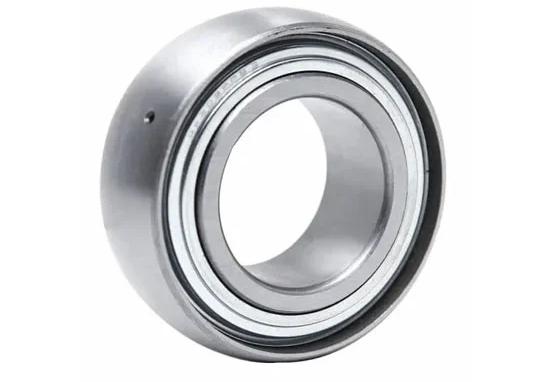
A hanger unit bearing is distinguished primarily by its housing and mounting configuration rather than by an entirely different bearing principle.
The unit normally combines a spherical outer-diameter bearing insert with a purpose-designed hanger housing. The self-aligning relationship between the insert and housing can accommodate limited static shaft misalignment, while the wider inner ring provides a practical interface for securing the bearing to the shaft.
The housing is what makes the configuration distinctive. Pillow block bearings are typically secured to a supporting surface through a base, while flange units attach to a machine wall or plate. Hanger bearing units are designed around a threaded mounting point, allowing the bearing position to be supported from an appropriate structural member.
This arrangement can be useful in conveying equipment, material handling systems, processing machinery and other installations where a rotating shaft needs support at an intermediate location but a conventional pedestal mounting surface is unavailable or impractical.
It is important not to treat a hanger bearing simply as an interchangeable version of another mounted bearing. The installation should be designed around the direction of the applied load, housing support, shaft position and surrounding machine structure. The correct mounted unit is the one whose housing configuration suits the actual mechanical arrangement.
Correct hanger bearing selection starts with verifying how the housing will connect to the supporting structure and where the shaft centerline must be positioned.
In a suspended shaft system, installation geometry can affect both assembly and long-term bearing behavior. The support should hold the housing securely without forcing the bearing away from the intended shaft centerline. If multiple bearings support the same shaft, the mounting points should also be positioned so the shaft does not have to bend or deflect simply to pass through each unit.
This is one reason self-aligning bearing inserts are useful in mounted bearing assemblies. They can accommodate limited static alignment variation between the insert and housing. However, self-alignment should not be used as a substitute for proper machine installation. Significant shaft bending, poor support positioning or structural movement can create loading conditions beyond what normal alignment compensation is intended to handle.
Buyers replacing an existing hanger unit bearing should record more than the bore size. Housing dimensions, mounting thread, shaft center height, surrounding clearance and the position of adjacent equipment should be checked before specifying an alternative unit.
For new equipment, providing a drawing of the installation can help the bearing supplier understand how the housing will be supported and identify dimensional issues before the equipment reaches assembly.
The shaft locking method determines how the bearing insert is secured and should be evaluated together with shaft condition, installation procedure and maintenance requirements.
Set screw locking is widely used in mounted bearing applications. Screws in the extended inner ring engage with the shaft to hold the insert in position. The arrangement is familiar to maintenance teams and provides a straightforward installation method when the shaft and operating conditions are suitable.
A concentric locking collar uses a different approach by creating a more uniform clamping relationship around the shaft. This can be useful when the equipment designer prefers concentric shaft locking rather than localized set screw contact.
Neither method should automatically be considered the best choice for every machine. Shaft tolerance, speed, rotational behavior, assembly requirements and maintenance procedures all influence the decision.
| Hanger Unit Configuration | Locking Method | Selection Focus |
|---|---|---|
| UCHA2 Type | Set screw locking | Conventional shaft locking and straightforward installation |
| UEHA2 Type | Concentric locking collar | Applications where concentric shaft locking is preferred |
| UCHE2 Type | Set screw locking | Alternative hanger housing configuration for compatible mounting designs |
When replacing an existing unit, keeping the original locking principle can simplify installation, provided that the existing design has performed satisfactorily. When developing new equipment, the locking method can instead be evaluated as part of the overall shaft and bearing system.
A hanger unit that physically fits the shaft may still be unsuitable if its lubrication and protection are poorly matched to the operating environment.
Industrial shafts can operate under very different conditions. A bearing used in a clean indoor conveying system faces different challenges from one installed around dust, moisture, elevated temperature or frequent equipment cleaning. These conditions influence grease selection, sealing requirements and maintenance intervals.
Lubrication should be selected according to operating temperature, speed, load and environmental requirements rather than simply using the same grease for every machine. Where food processing or other application-specific requirements are involved, a suitable grease specification may also need to be confirmed with the bearing supplier.
Maintenance access deserves consideration at the design stage. A hanger unit may be physically positioned above or within machinery, so technicians need practical access for inspection and lubrication. A bearing that is difficult to service can increase maintenance time even when its basic load capability is appropriate.
Contamination should also be evaluated. Dust and foreign particles entering the bearing can degrade lubricant and accelerate wear. Where the surrounding process produces significant contamination, additional protective measures such as appropriate sealing or covers may be considered according to the specific machine arrangement.
For buyers comparing different mounted bearing configurations, LDK's broader bearing product range can also help determine whether a hanger unit or another housing style better matches the installation.
Providing installation and operating information allows a supplier to evaluate the complete application rather than selecting a bearing from bore size alone.
For a direct replacement, the existing unit number is an excellent starting point, but it should be supported by dimensional information whenever possible. Shaft diameter, housing dimensions and mounting details help confirm interchangeability, particularly when comparing products from different sources.
For an OEM project, the equipment application provides additional context. The supplier should understand how the shaft is supported, the expected rotational speed, approximate radial and axial loading, operating temperature, contamination exposure and whether the unit requires special lubrication.
A drawing can be especially useful for hanger bearing applications because it shows the relationship between the threaded housing connection, shaft and supporting structure. This may reveal installation constraints that are not obvious from a simple bearing designation.
These details also help prevent over-specification. A bearing does not become a better choice simply because it has a larger housing or a more complex locking system. Efficient selection means matching the unit to the actual mechanical and environmental requirements of the equipment.
A hanger bearing unit should be selected as part of a shaft support system, not as an isolated component. The housing mounting arrangement determines how the bearing integrates with the machine, while the insert, locking method, lubrication and environmental protection influence how the unit performs after installation.
For replacement projects, dimensional compatibility and shaft locking deserve careful attention. For new equipment, evaluating the bearing together with the supporting structure can make assembly and future maintenance considerably easier.
LDK offers hanger bearing configurations including UCHA2, UEHA2 and UCHE2 series, with set screw and concentric locking options for different shaft arrangements. Application-specific lubricant and housing options can also be discussed when required. If you are selecting a unit for an OEM design or replacing an existing hanger bearing, you can contact LDK with the bearing number, shaft information and application details for further evaluation.
A hanger unit bearing supports a rotating shaft where the machine design requires a suspended or intermediate mounting position. Its housing differs from conventional pedestal-style units and is designed to connect to an appropriate supporting structure through a hanger-style mounting arrangement.
Hanger units with self-aligning spherical bearing inserts can accommodate limited static misalignment between the insert and housing. However, this capability should not be used to compensate for major installation errors, excessive shaft deflection or incorrectly positioned supports.
Set screw locking secures the extended inner ring to the shaft at specific contact points, while a concentric locking system clamps more uniformly around the shaft. Selection depends on the shaft design, operating requirements, installation method and maintenance preferences.
Start with the existing bearing designation if available. Shaft diameter, housing dimensions, mounting thread, center height, locking method and available installation space should also be confirmed. For alternative products, operating speed, load, temperature and environmental conditions can help verify suitability.


